What Does It Really Mean to Be Child-Centred?
At Barcelona Montessori School, "child-centred" is not a tagline on a brochure. It is a daily commitment — written into our values, expressed in how our classrooms are designed, and lived in every interaction between our guides and the children in their care. But what does it actually mean in practice? And what does it not mean?
This post tries to answer that honestly.
The Child at the Centre of Decision-Making
Being child-centred starts with a question we ask constantly: Is this serving the child?
It shapes how we arrange furniture, which materials sit on the shelves, how long a work period lasts, and when — or whether — a child is assessed. But it does not mean that children make every decision, or that adults have no authority. Quite the opposite.
A child-centred environment is one of freedom within structure. Children are trusted with real choices; adults hold the boundaries that make those choices meaningful. Knowing which decisions belong to whom is one of the most important things we practise here every day.
Decisions That Belong to the Child
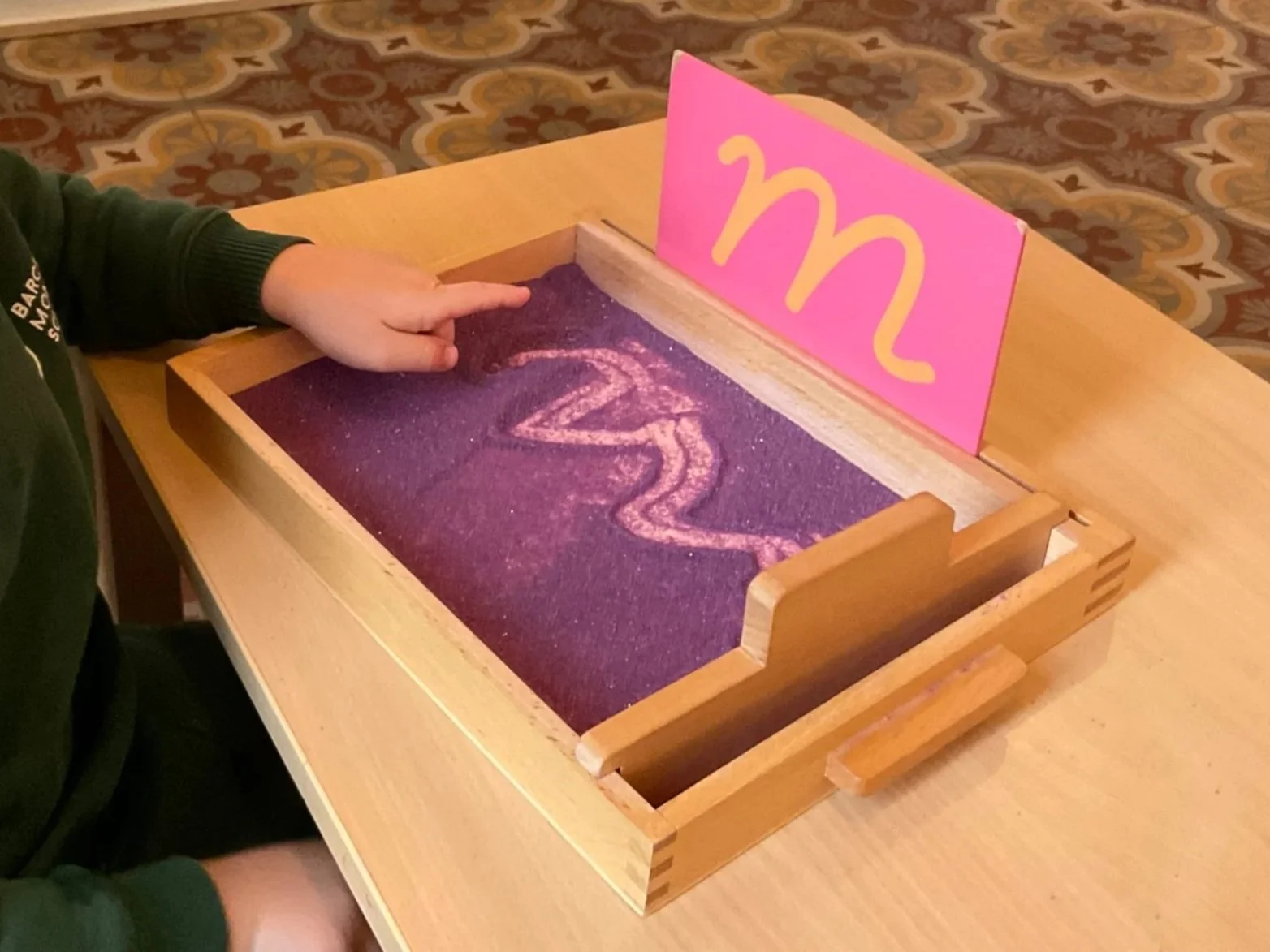
M is for Marc, who loves the sandpaper letters
Within our prepared environment, children have genuine autonomy over several things:
What they work on. During the extended work cycle — typically a two to three hour uninterrupted block — children choose freely from materials on which they have received a lesson. In Children’s House, a child drawn to the sandpaper letters will spend an hour there. Another will return to the bead chain. Another will sit with a friend and build a grammar sentence together. This is not free play; it is self-directed work. The difference matters.
How long they spend on something. There is no bell cutting off a child mid-concentration. If a child is deep in a piece of work, they finish it. This respect for deep focus — what Montessori called normalisation — is one of the most powerful features of our approach. Research published in Frontiers in Education confirms that this kind of self-regulation, built through daily practice of free choice within clear limits, measurably improves children's attention and impulse control over time.
Where and with whom they work. A child may work at a table, on a mat on the floor, alone, or alongside a classmate. They move freely and purposefully through the classroom. As long as they are working, they have the freedom to choose how and where.
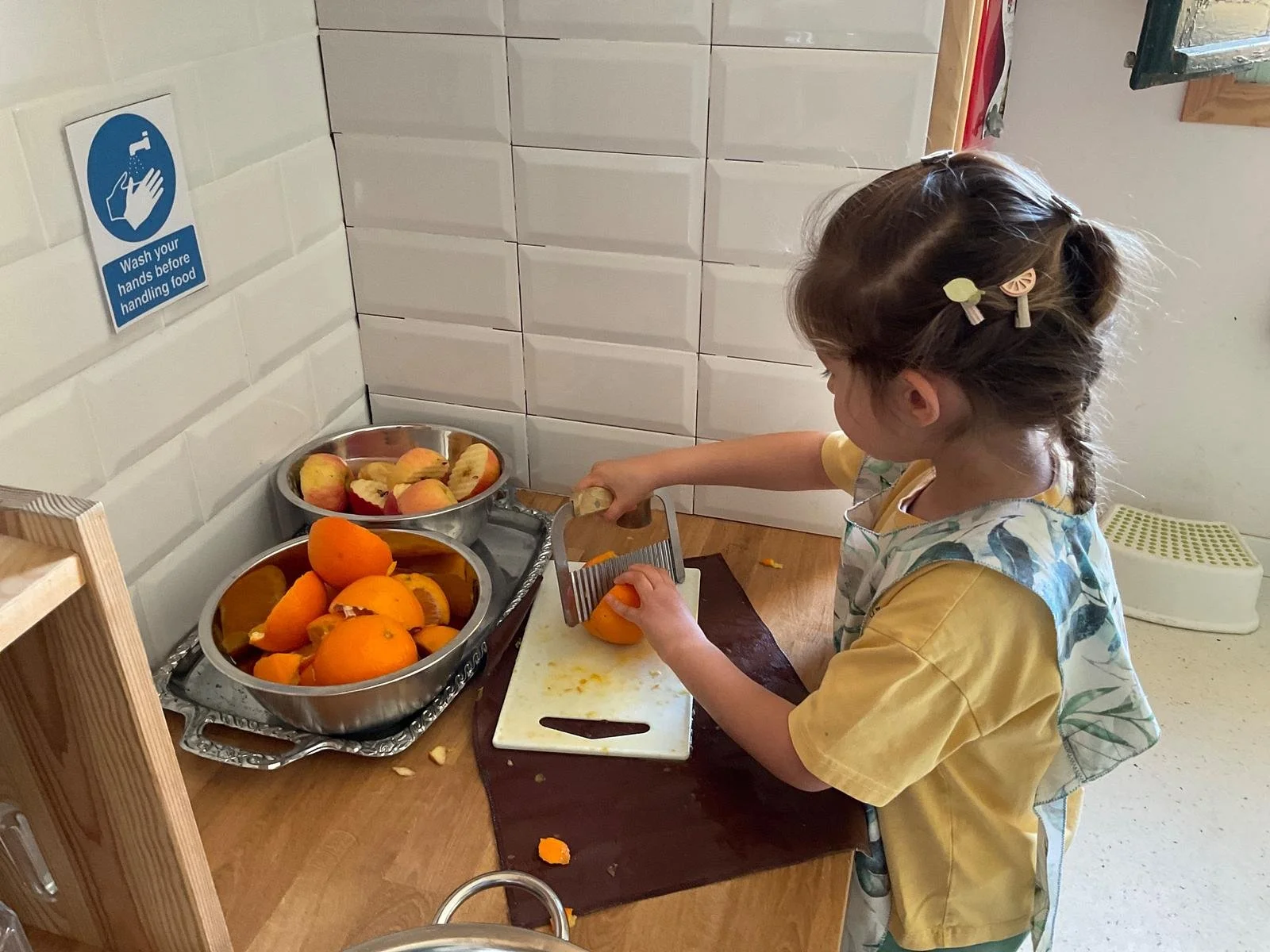
Children’s House Student preparing snack for her friends
When they are ready for a snack. Practical life choices — when to eat, how to pour their own drink, how to clean up afterwards — are part of the curriculum. They are not small things. At lunchtime, students are guided to try new foods and make healthy choices.
What they are curious about. In Primary (ages 6–12) and Adolescence, children increasingly direct their own research. A child fascinated by volcanoes may spend weeks building a project around them. Another captivated by fractions will go deeper into mathematics. The guide's role is to observe, offer the next material at the right moment, and trust the child's drive. In Adolescence, students regularly develop new
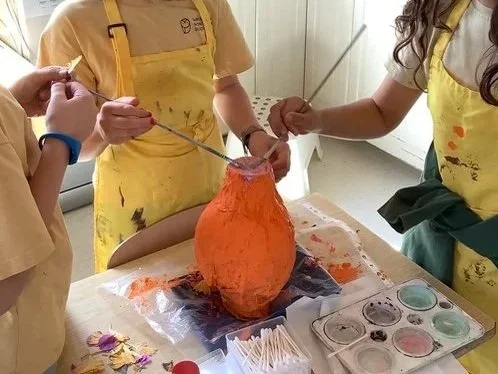
3 students from Ferrer work on their project about Ancient Greece
Decisions That Belong to the Adults
Child-centred does not mean adult-free. There are decisions that genuinely belong to the Guides (teachers) and the school community — not because adults know best about everything, but because children are still developing the experience and judgement to navigate them.
The structure of the day. We design the rhythm of the school day — arrival, work cycle, outdoor time, lunch, rest — because children thrive in predictable routine. This is not imposed on children; it is given to them as a gift of security.
Which materials are available. Guides (teachers) carefully curate and sequence the environment. Not every material is available to every child at every moment; each is offered when the child is developmentally ready. This is a deep form of respect, not restriction.
Health and safety. Decisions about physical safety, illness, and wellbeing are made by trusted adults. Children are not asked to manage these. Clear limits keep everyone safe and healthy.
The overall curriculum framework. Children do not decide whether to encounter mathematics, language, or cultural studies — those are adult responsibilities. But how and when within that framework a child engages is largely up to the child.
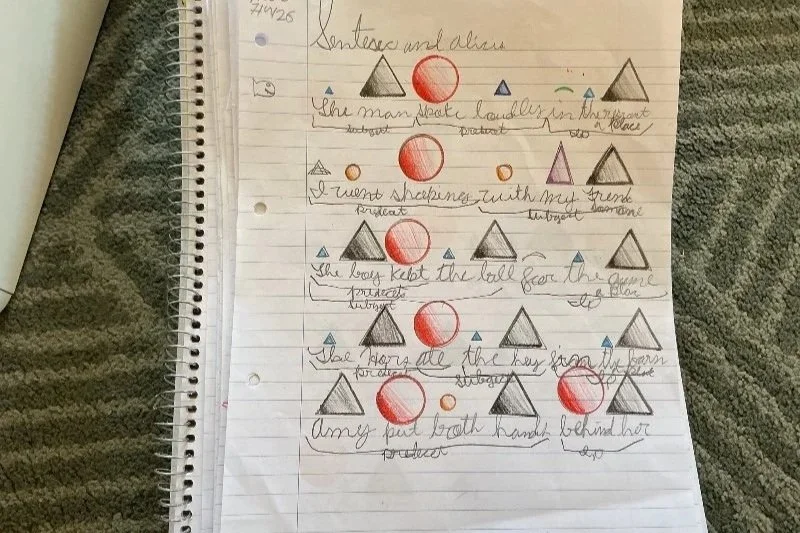
Sentence analysis in Lower Primary
Transitions between levels. Moving a child from Children's House to Primary, or from Lower to Upper Primary, is a decision guided by careful observation and conversation between guides, the family, and the leadership team.
On Testing and Assessment: Only When the Child Is Ready
Perhaps nowhere is the child-centred approach more different from conventional schooling than in how — and when — we assess learning.
In most traditional schools, tests happen on a fixed timetable. All children of the same age sit the same exam at the same time, regardless of where each individual is in their understanding. This tells us something about the cohort. It tells us very little about the child.
At BMS, assessment is continuous and observational. Our Guides (teachers) watch children work every day. They note what a child reaches for, what they avoid, where they get stuck, where they fly. Progress is documented through observation portfolios, not only grades. A child is never surprised by an assessment, because assessment is simply part of the ongoing conversation between guide and child.
Formal presentations of knowledge — when a child shows what they have learned — happen when the child is ready, not when the calendar says so. This is backed by a considerable body of research on child development.
As students get older and move closer to the end of Primary some formal testing takes place. This is designed to give students the experience of revising for and taking tests. Results are read in context and used alongside other observations and evidence of student progress.
In the Adolescent program, tests and exams are more common. End of topic tests are taken by students at agreed times and end of year exams form an important part of the academic calendar where Guides are conscious to allow sufficient time and ensure a balanced workload. This approach allows students the time and practice to be ready for official exams and assessments that take place at 16 and 18, whilst still offering a rich school curriculum that encourages students to follow their interests.
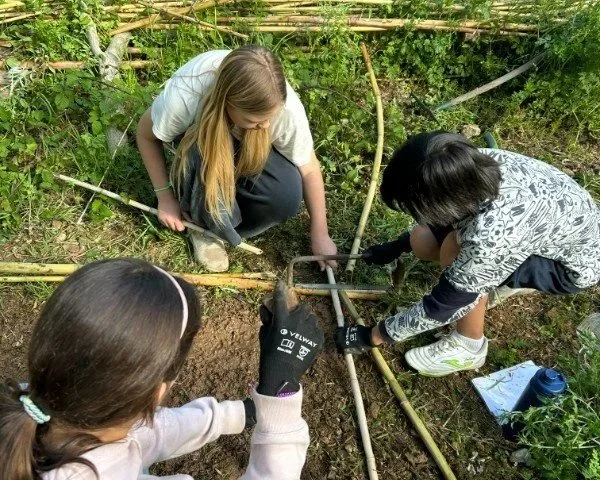
Adolescent students working in the garden
What the Research Tells Us
Maria Montessori identified what she called sensitive periods: windows in development when a child is neurologically primed to absorb particular types of information almost effortlessly. Stanford neurobiologist Eric Knudsen's brain research later confirmed this: "When the effect of experience on the brain is particularly strong during a limited period in development, this period is referred to as a sensitive period. Such periods allow experience to instruct neural circuits to process or represent information in a way that is adaptive for the individual."
These sensitive periods give us a guide — not a rigid timetable — for when formal academic learning tends to emerge naturally:
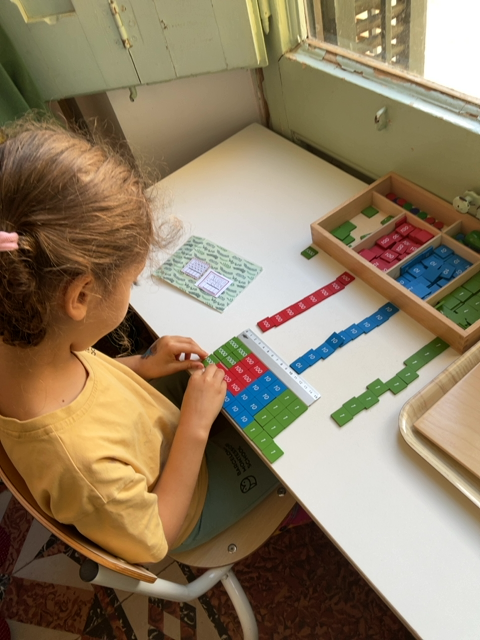
A Children’s House student works on maths using the Stamp Game
Language (birth to age 6): Children are in a sensitive period for spoken language from birth. Around age 3–4, interest in letters and sounds typically emerges. In Montessori environments, writing often precedes reading: children begin encoding sounds with the moveable alphabet before they decode text. Research shows that some Montessori children are reading and writing fluently before the age of six — not because they were pushed, but because the environment met them at the right moment.
Mathematics (ages 3–6 and into elementary): Number sense begins to develop early through concrete, sensorial materials. The bead chains, the golden beads, the number rods — these allow children to understand quantity before they work with abstract symbols. By the time children move into Elementary (around age 6), they are typically ready to engage more formally with arithmetic, fractions, and geometry. A 2025 longitudinal study published in a peer-reviewed journal found that Montessori's early mathematics approach through manipulatives shows particularly strong effects on mathematical problem-solving — sometimes with benefits that become more pronounced as children grow older.
Abstract reasoning (from around age 6–7): Developmental theorists from Montessori to Piaget to Erikson converge on the idea that around age 6, a significant cognitive shift occurs. The child moves from primarily concrete, sensorial learning toward the capacity for more abstract thought. This is not a fixed date — it is a tendency, and one every guide observes individually in each child. It is precisely when we begin introducing the Great Lessons in Elementary: the big stories of the universe, life on Earth, human history, mathematics, and language.
Adult wellbeing as a long-term outcome: A 2025 study published in Frontiers in Developmental Psychology, drawing on nearly 2,000 adults, found that attending Montessori during the preschool years (ages 3–6) predicted higher adult wellbeing — and that the longer a person attended Montessori, the stronger this effect.
The implication of all this is simple: rushing a child toward formal academic content before they are ready does not produce better outcomes. It produces anxiety, a loss of intrinsic motivation, and a broken relationship with learning. Waiting — not passively, but actively preparing the environment and watching for readiness — produces children who learn deeply and joyfully, on their own terms.
Trust as a Practice
All of this rests on something that sounds simple but takes real courage to live: trust in the child.
It is harder than it sounds. Adults are used to directing, measuring, and controlling. The instinct to intervene, to correct, to move the child along is always present. Being child-centred means noticing that instinct — and asking, each time, Is this for the child, or for me?
When we design our environments, write our policies, and make decisions about learning, the child is always our reference point. Not what is convenient for adults, not what looks impressive from the outside, and not what a standardised test will measure next year.
That is what child-centred means at BMS. And it is what we invite every family who joins us to practise alongside us — because it is not only a school philosophy. It is a way of seeing a child.